18+ only. Crypto gambling involves risk - never wager more than you can afford to lose. Some links may be affiliate links; rankings stay independent. Gamble responsibly.
The strongest full casino with real XMR support - but Trustpilot removed its profile for fake reviews and its astroturf campaign is documented. Trust the payouts, not the hype.
Working no-frills XMR dice with a genuinely chain-verifiable fairness mode and an operator who answers complaints - but anonymous, unlicensed, and its blackjack is currently offline with a 'critical vulnerability'. Fine for small rolls; there is no recourse if it disappears.
One of the oldest XMR gambling domains (since 2018), relaunched in 2025 as an accountless coinflip/roulette/dice site with a public bankroll. The single non-payment complaint was answered on-chain; still an anonymous one-man custodial operation, so size your bets accordingly.
Purity-first XMR dice with a Tor mirror and on-chain fairness, but currently hiding behind an interactive Cloudflare challenge with zero community track record. The accountless model caps your exposure at one bet - never send more than you can lose to an anonymous wallet.
A working XMR over/under dice game with a documented provably-fair scheme, but the operator's own page admits a 10% edge on over/under and 33% on sevens - predatory versus ~1% crypto-dice norms - and the loss-funded progressive pool is an unsecured IOU from an anonymous operator with no contact channel.
Provably fair dice is one equation: multiplier = 99 / win-chance. 49.5% pays 2x, 9.9% pays 10x, 1% pays 99x [1]. The missing point in every numerator is the house edge - 1% of turnover, identical at every settings combination. That is why dice is the reference point for price discovery on every XMR site: it is the only game where the edge is printed in the payout formula rather than hidden in a paytable.
The edge league on this page right now: best documented edge 1%, worst 10% - and the spread matters more than any bonus. 100% of the operators here carry a provably fair implementation; for the rest, trust in the RNG is trust in the operator's auditor.
Martingale: the math was settled a century ago
Doubling after every loss is the most-recommended, least-understood "system" in gambling. The math from the standard reference [2]:
Expected value is additive: each bet carries -1% expectation, so any sequence of bets, sized any way, has negative expectation.
The 10-loss Martingale sequence costs 1,023x your base bet - a real bankroll wipeout that the doubling recovers only when a win arrives before the streak.
With a table limit or finite bankroll (both always exist), ruin probability is nonzero and the doubling just concentrates it: a modest 6-loss streak has roughly 84% probability of occurring within 200 bets at near-coinflip odds [2].
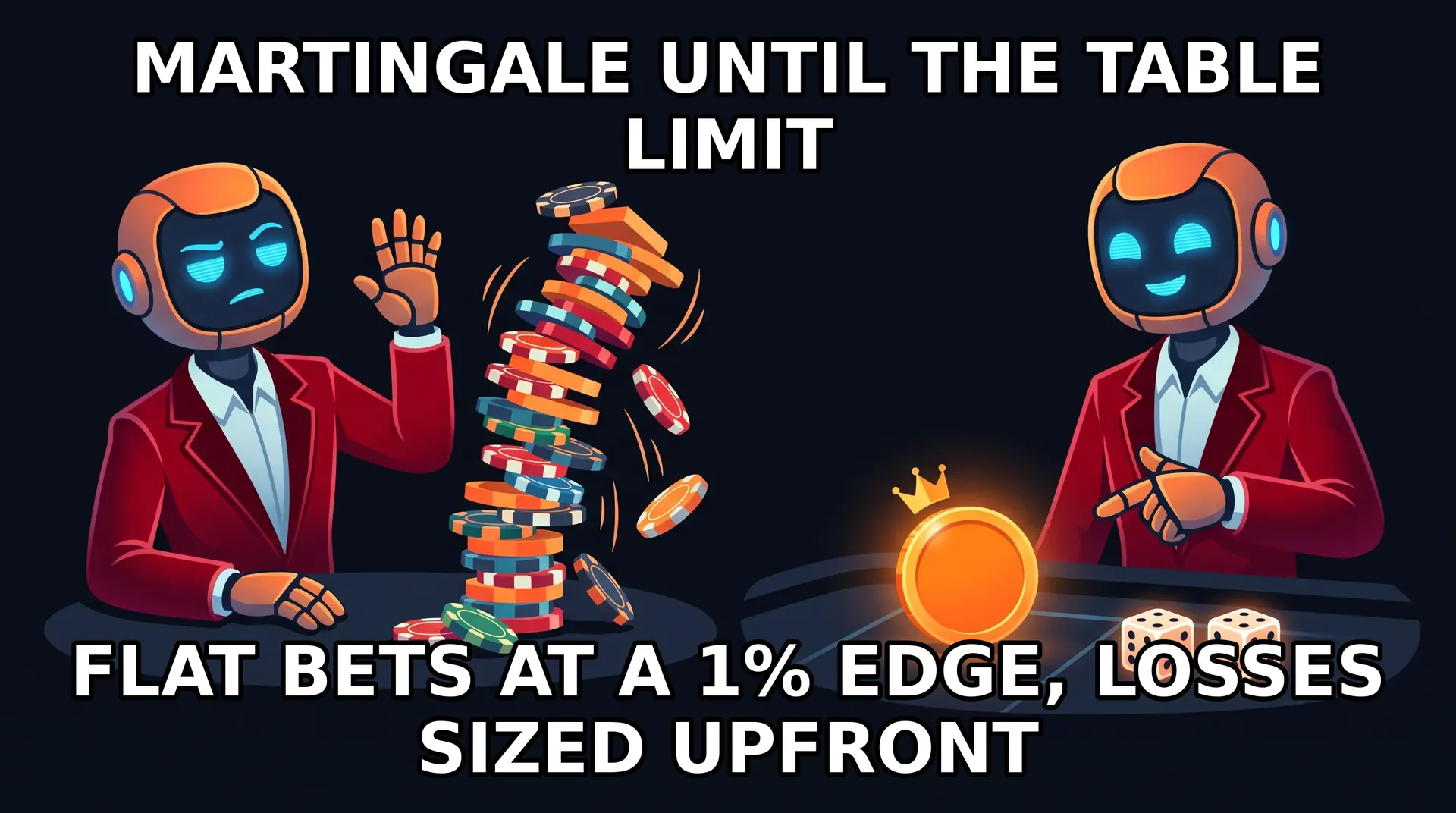
The Martingale staircase against a 20-unit table-limit: the doubling chain that ends in one unrecoverable step.
Tip: Size flat bets so the session survives the variance you want to play through. The house-edge calculator converts edge x volume into the expected cost of a session - that number, not the payout screen, is what you are paying.
Verifying rolls in 4 steps
Before betting, note the hashed server seed the site publishes.
Play; then request the revealed server seed and check it hashes to the original.
Recompute a few rolls from server seed + your client seed + nonce - paste the triple into the provably fair verifier.
Rotate seeds after losing streaks so the operator cannot precompute against a fixed client seed.
If a site cannot produce step 1, it is not provably fair - it is a claim. The provably fair guide covers the full commit-reveal cycle and its failure modes.
Dice built the crypto casino industry
The lineage matters because it explains the market's shape: SatoshiDice was the largest Bitcoin gambling service of the early era, and in 2013 analysts attributed somewhere between 25% and 50% of all Bitcoin network transaction volume to online gambling, mostly that one site [4][3]. Every XMR dice site on this page is a descendant of that model - tiny operator, tiny overhead, provable math - with all the operator-risk consequences that implies.
Live values from our database - details and caveats in each review. "Visit" links may be affiliated.
67% of the dice operators here need no account at all. Before depositing, skim the scam watch list and size the bankroll to the operator's age - the dice UI is identical everywhere; the counterparty is not.
Multiplier = 99 / win-chance. Pick a 49.5% chance and the multiplier is 2x; pick 1% and it is 99x. The "99" is the edge - one unit in every hundred wagered stays with the house. Operator documentation confirms the same 1% figure on XMR-capable dice sites.
Does Martingale work if I have a big enough bankroll?
No. The expected value of each bet is negative, so doubling after losses only increases the average loss; the strategy fails whenever there is any limit on bets or earnings. The only thing a bigger bankroll buys is a lower probability of a specific-size ruin, never a positive expectation.
What win chance should I pick?
Expected loss is the same at any win-chance (edge x volume). Low win chances give long sessions and high variance per win; high win chances give frequent small wins and faster grind toward the edge. Pick for variance comfort, not for "value" - the edge does not care.
How do I verify a dice roll?
Get the site's server seed (hashed before the round, revealed after), combine it with your client seed and the bet nonce, and recompute the roll hash. The verifier on this site does the arithmetic for documented schemes; the provably fair guide explains the commit-reveal cycle.
Is a 2% edge on dice acceptable?
It is exactly twice the market baseline - you pay twice the expected cost per wager for the identical game. At 2.65% (a documented XMR slots-and-dice site edge) it is closer to three times. Treat anything above ~1.5% as a price you must be able to justify.
Do dice sites need accounts?
The XMR-native ones here are accountless: deposit to a generated address, play against a session balance, withdraw to yours. That is the whole account system - and it is also why operator risk, not identity risk, dominates this category.