18+ only. Crypto gambling involves risk - never wager more than you can afford to lose. Some links may be affiliate links; rankings stay independent. Gamble responsibly.
Working no-frills XMR dice with a genuinely chain-verifiable fairness mode and an operator who answers complaints - but anonymous, unlicensed, and its blackjack is currently offline with a 'critical vulnerability'. Fine for small rolls; there is no recourse if it disappears.
Genuinely XMR-native and accountless with a documented provably-fair scheme, but run by an anonymous operator with a near-zero track record. Fine for small-stakes play; do not keep a balance or chase a big win you cannot verify will be paid.
No KYCXMR nativeProvably fairXMR-only site
Referral: after wagering 1 XMR you unlock a code; when a referred player wagers 0.2 XMR total, both get 0.0025 XMR. No deposit welcome bonus.Referral bonus only (0.0025 XMR both sid…
One of the oldest XMR gambling domains (since 2018), relaunched in 2025 as an accountless coinflip/roulette/dice site with a public bankroll. The single non-payment complaint was answered on-chain; still an anonymous one-man custodial operation, so size your bets accordingly.
Self-service Plinko with a documented commit-reveal scheme, PGP-signed receipts and automatic on-chain payouts - but the operator is anonymous, the bankroll is a single hobbyist wallet, and no third party has ever reviewed it.
XMR-only prediction markets with a 0.4% rake and a PGP warrant canary, but balances are custodial USD ledger entries and the same anonymous team resolves markets and controls payouts - you are trusting one operator with the money, the odds and the results.
Provably fair Monero raffles with a real, on-chain-auditable payout record - but an anonymous, legally self-contradictory operation that raffles firearms into a US legal gray zone, and winning a physical prize means handing your identity to someone you cannot identify.
A genuinely XMR-native, zero-KYC prediction market with best-in-class agent/API integration - but it is openly custodial, run by an anonymous (ex-XMR.BAR) team, and barely three months old with almost no users. Treat it like an unproven exchange: deposit only what you are about to bet and withdraw immediately.
No KYCXMR nativeVPN friendlyXMR-only site
No welcome bonus. Referral program: 25% of referred users' trading fees for 6 months from their signup (operator FAQ, verified 2026-09-06).
Purity-first XMR dice with a Tor mirror and on-chain fairness, but currently hiding behind an interactive Cloudflare challenge with zero community track record. The accountless model caps your exposure at one bet - never send more than you can lose to an anonymous wallet.
Fully on-chain, accountless Monero plinko with a sound HMAC-SHA512(seed+TXID) fairness scheme - but the site is down, and its announced relaunch already slipped once ("mid-September" per the current notice, checked 2026-09-13). Do not send funds until the game is verifiably live again.
Working no-KYC XMR swap with a bolted-on provably-fair mini casino - but unlicensed, five months old, and its review layer looks botted (Monerica flag). Casino play runs on BTC sats, not XMR; tiny test amounts only.
No KYCProvably fairVPN friendlywatch
25% deposit match, capped at 500,000 sats (personal offers to players with history)50x on granted bonus; 7-day active windo…
Real XMR-native no-registration poker with a clean 1%-rake model - but the tables are empty and Monerica twice flagged it Scam over non-returned funds before quietly re-admitting it. Play micro-stakes only, never leave a balance sitting.
A working XMR over/under dice game with a documented provably-fair scheme, but the operator's own page admits a 10% edge on over/under and 33% on sevens - predatory versus ~1% crypto-dice norms - and the loss-funded progressive pool is an unsecured IOU from an anonymous operator with no contact channel.
Tor-only XMR scratchcards with a three-week history, no reviews and a Monerica listing pulled when the site went offline. The clearnet gateway is back (2026-09-06), but the casino itself remains Tor-only and untested by us - minimum deposit only if you test it over Tor.
"No KYC" is a spectrum, and the differences live in the terms, not the homepage. Three triggers show up repeatedly across the operators on this page [1]:
Risk-based triggers. The largest group (every email-only operator here) runs KYC never by default but reserves the right on fraud patterns or outsized wins. That is not a broken promise - it is an explicit clause, and it comes with a number attached: the win threshold above which a manual review can start.
Blockchain screening. Licensed operators increasingly screen deposits with analytics tools and freeze flagged funds before processing [3]. Curaçao's 2025 AML ruling makes this mandatory for its licensees, with Monero itself classified as enhanced risk requiring written regulator approval [3]. What this means for you: the provenance of the coins you deposit is the new KYC.
Jurisdictional blocks. Several operators geo-block regulated markets rather than KYC you - a cleaner outcome for privacy, but check the VPN clause (the Tor & VPN-friendly list sorts this out per operator).
The trigger thresholds we verified are in each review, dated. 92% of the operators on this page are fully accountless.
Where the paper trail really starts
The casino asks nothing - the exchange does. Two regulatory facts matter for anyone who still buys XMR on a KYC venue:
FATF Recommendation 16 ("Travel Rule") extends to Virtual Asset Service Providers, with originator and beneficiary information required on covered transfers [5]; the FATF standard applies it above USD/EUR 1,000 [1].
The EU's implementation under MiCA's TFR package goes further: no de-minimis threshold at all for CASP-to-CASP transfers, plus enhanced identity checks when transfers above EUR 1,000 touch self-hosted wallets [1][2].
Translation: a 2 XMR withdrawal straight from your exchange account to a casino writes both endpoints into a regulated data flow. The cheap fix costs one extra hop - see the next section.
Tip: The XMR buying guide ranks acquisition paths by the identity they leave behind. If your threat model includes "exchange links me to gambling", read it before depositing.
Deposit hygiene that works
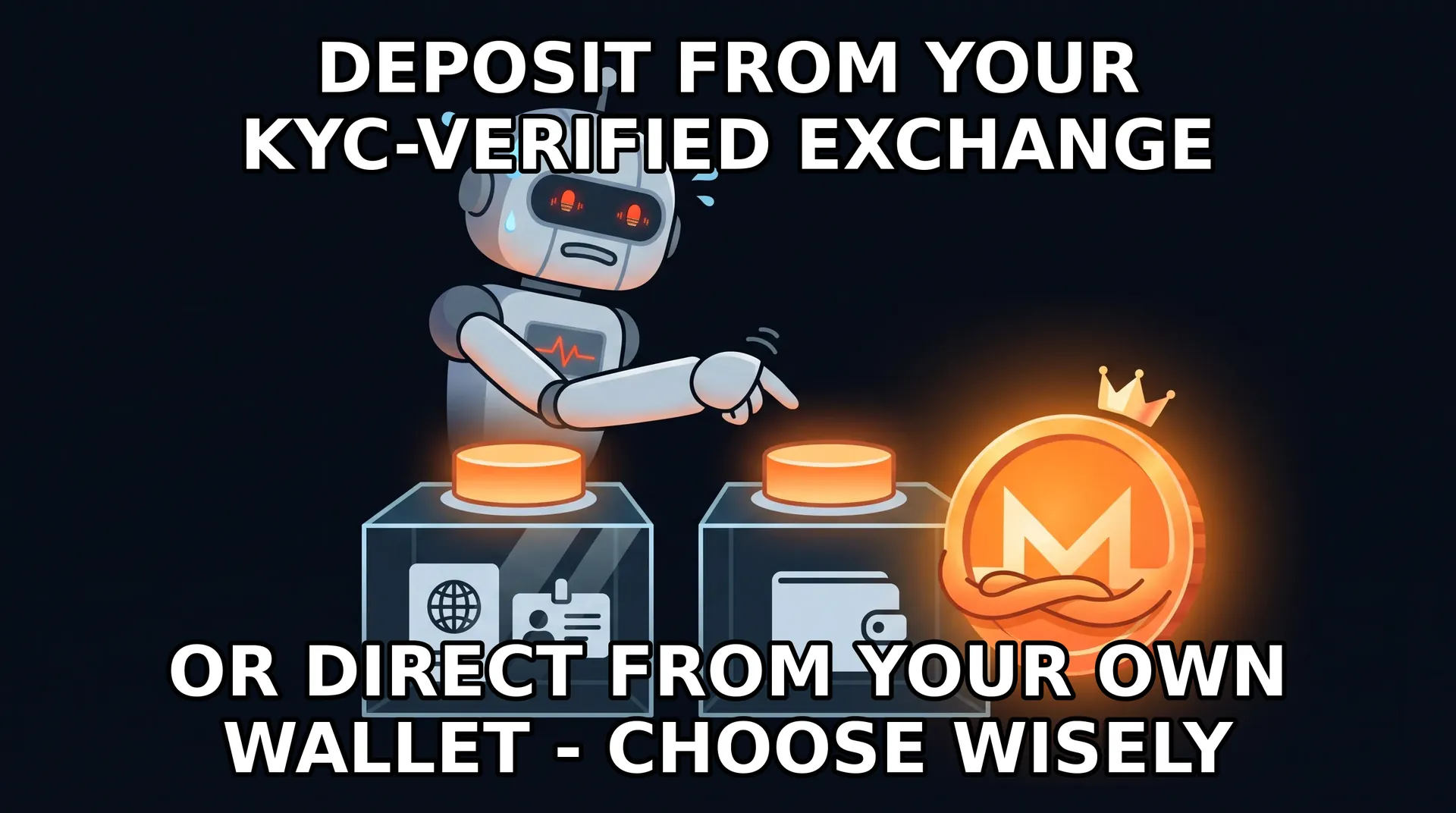
Own wallet first, always. Withdraw from the exchange to a wallet you control, then deposit from there. One on-chain hop severs the account linkage the Travel Rule creates [1].
One subaddress per casino. Monero addresses are free - use a fresh subaddress per operator so incoming payouts can never be clustered across sites.
Aim deposits below trigger thresholds. The documented kyc_trigger_usd values on this page (where the operator publishes one) are the number to stay under if you want the no-KYC promise to survive a big session.
Remember the 10-block lock. Even at a no-KYC site, received XMR is spendable only after ~10 confirmations (~20 minutes) [4]. Plan session starts around it.
How to read a "no-KYC" claim like a pro
Marketing says "no KYC". The terms say the truth. Before depositing anywhere on this page, read the review's KYC field and look for these patterns:
Pattern in the terms
What it actually means
"KYC never required"
The strongest claim - verify it has a date and a source
"KYC only in exceptional cases"
Risk-based: an unnumbered trigger is a discretionary trigger
"KYC above $X in winnings"
Fine for most sessions - know the number before you bet big
Silent on KYC
Not the same as no KYC - unverified beats unclaimed
The KYC deep-dive guide walks through the whole taxonomy with quoted clauses.
The KYC decision points between deposit and payout - and which ones a no-KYC operator actually controls.
Live values from our database - details and caveats in each review. "Visit" links may be affiliated.
None of this changes the operator-risk math: 13 operators make this list, and small no-KYC sites fail more often than big brands. The honest play is small deposits, fast withdrawals, and the scam watch list on your reading rotation.
Which triggers turn a no-KYC casino into an ID request?
The three documented ones are fraud patterns on your account, wins above the risk threshold written in the terms, and deposit screening hits from blockchain-analytics tools. Every review on this site quotes the exact trigger threshold - check it before sizing a deposit.
Does using an exchange to buy XMR undo the no-KYC benefit?
It creates an identity link on the buy side: EU CASPs must exchange originator and beneficiary data for all transfers under the MiCA-era Travel Rule, with extra checks above EUR 1,000. Withdraw to your own wallet first - the casino should never share context with your exchange account.
Can a casino freeze my deposit without KYC?
Yes. Curaçao's 2025 AML ruling requires licensed operators to screen deposits with approved analytics vendors and freeze funds above risk thresholds. Screening happens before processing, so the question is exposure history of the coins you deposit, not your documents.
Is accountless actually stronger than email-only?
Yes, structurally. Accountless sites hold no identifier that can leak - there is no users table to breach or subpoena. Email-only operators hold a contactable identity; it is acceptable for most threat models but it is a data point you cannot take back.
What is the riskiest part of a no-KYC setup in practice?
The operator, not the paperwork. No-KYC sites are small, lightly regulated and can vanish. Size deposits to what you can lose, withdraw wins promptly, and prefer operators with a track record you can verify in the reviews.
Do no-KYC casinos pay out large wins?
The honest answer is: it depends on the operator's liquidity, not its KYC page. Some micro sites pay six-figure wins without friction; others stall. Read the withdrawal_notes and max-withdrawal fields in each review - they carry more signal than the marketing.