18+ only. Crypto gambling involves risk - never wager more than you can afford to lose. Some links may be affiliate links; rankings stay independent. Gamble responsibly.
Working no-frills XMR dice with a genuinely chain-verifiable fairness mode and an operator who answers complaints - but anonymous, unlicensed, and its blackjack is currently offline with a 'critical vulnerability'. Fine for small rolls; there is no recourse if it disappears.
Self-service Plinko with a documented commit-reveal scheme, PGP-signed receipts and automatic on-chain payouts - but the operator is anonymous, the bankroll is a single hobbyist wallet, and no third party has ever reviewed it.
XMR-only prediction markets with a 0.4% rake and a PGP warrant canary, but balances are custodial USD ledger entries and the same anonymous team resolves markets and controls payouts - you are trusting one operator with the money, the odds and the results.
Provably fair Monero raffles with a real, on-chain-auditable payout record - but an anonymous, legally self-contradictory operation that raffles firearms into a US legal gray zone, and winning a physical prize means handing your identity to someone you cannot identify.
A genuinely XMR-native, zero-KYC prediction market with best-in-class agent/API integration - but it is openly custodial, run by an anonymous (ex-XMR.BAR) team, and barely three months old with almost no users. Treat it like an unproven exchange: deposit only what you are about to bet and withdraw immediately.
No KYCXMR nativeVPN friendlyXMR-only site
No welcome bonus. Referral program: 25% of referred users' trading fees for 6 months from their signup (operator FAQ, verified 2026-09-06).
Purity-first XMR dice with a Tor mirror and on-chain fairness, but currently hiding behind an interactive Cloudflare challenge with zero community track record. The accountless model caps your exposure at one bet - never send more than you can lose to an anonymous wallet.
Working no-KYC XMR swap with a bolted-on provably-fair mini casino - but unlicensed, five months old, and its review layer looks botted (Monerica flag). Casino play runs on BTC sats, not XMR; tiny test amounts only.
No KYCProvably fairVPN friendlywatch
25% deposit match, capped at 500,000 sats (personal offers to players with history)50x on granted bonus; 7-day active windo…
Real XMR-native no-registration poker with a clean 1%-rake model - but the tables are empty and Monerica twice flagged it Scam over non-returned funds before quietly re-admitting it. Play micro-stakes only, never leave a balance sitting.
A working XMR over/under dice game with a documented provably-fair scheme, but the operator's own page admits a 10% edge on over/under and 33% on sevens - predatory versus ~1% crypto-dice norms - and the loss-funded progressive pool is an unsecured IOU from an anonymous operator with no contact channel.
Tor-only XMR scratchcards with a three-week history, no reviews and a Monerica listing pulled when the site went offline. The clearnet gateway is back (2026-09-06), but the casino itself remains Tor-only and untested by us - minimum deposit only if you test it over Tor.
There are three privacy postures an operator can take, and only the first two belong on this page:
Welcome it in writing. VPN/Tor-friendly terms - the operator's legal position is "we do not care how you connect".
Run an onion service. The strongest signal: the operator maintains Tor infrastructure as a first-class interface.
"Tolerated" in practice. No clause, no promise - and no recourse if a payout review reads your exit IP as a proxy. Not counted as friendly here, deliberately.
10 operators on this page sit in the first camp and 2 run their own onion services. The clauses are quoted verbatim in each review - because the VPN guide documents the pattern where operators accepted deposits over VPN and voided the withdrawal.
Onion addresses are self-authenticating - use that
The .onion v3 address is not a name that resolves - it is the service's own public key [1]. When your client connects, it verifies the service's descriptor signature against the key embedded in the address; an impostor presenting a different key simply cannot be the address you typed [1]. Consequences:
A phishing mirror can look identical and sit at a different onion - but it cannot steal your address. The attack works only if you let it hand you a new address.
The traffic never leaves the Tor network and is end-to-end encrypted [1] - no exit node, no CA, no middlebox.
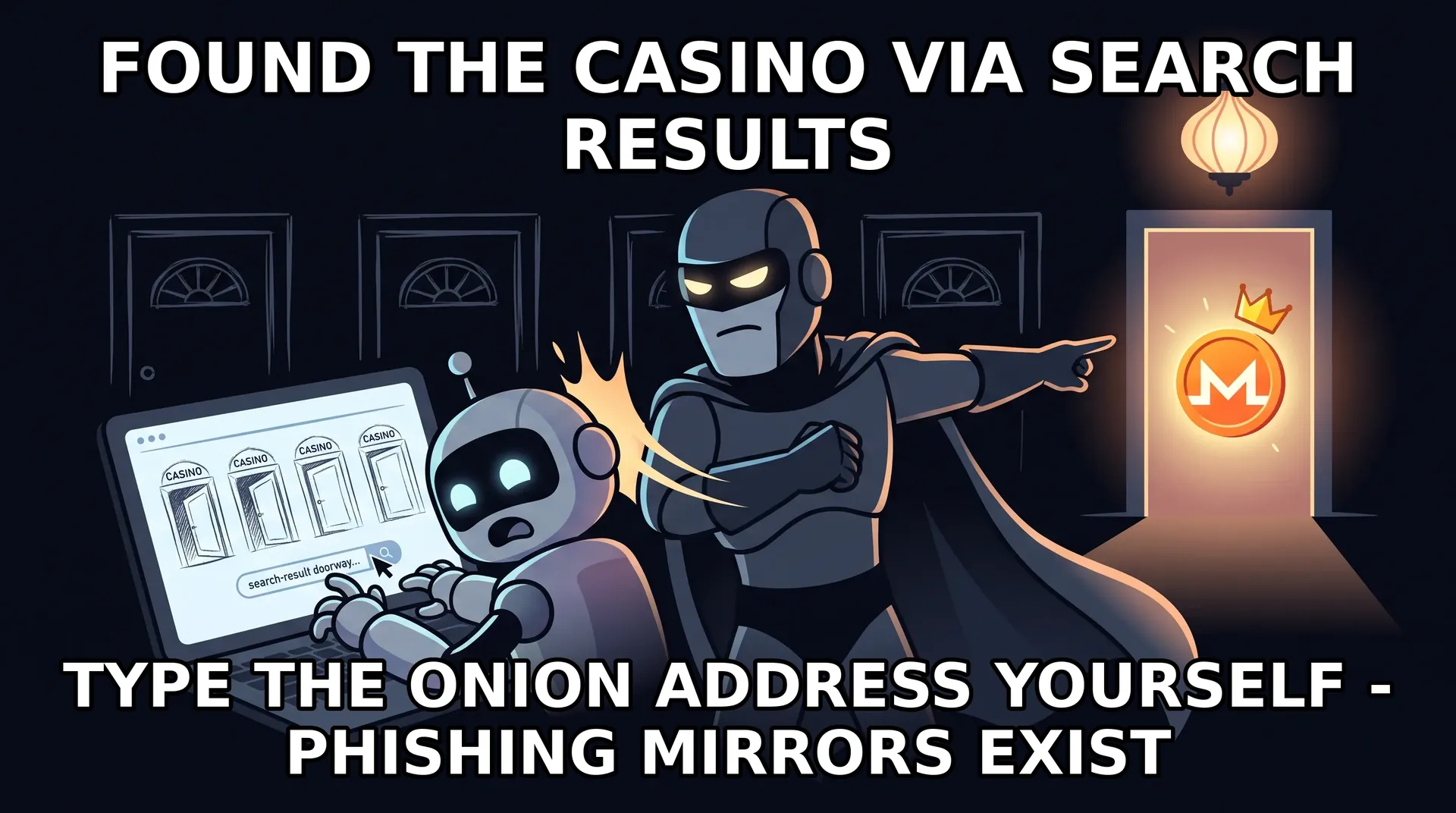
Warning: The documented attack pattern is real: a fake Monero wallet site (monero-wallet.io) impersonating getmonero.org to harvest credentials [3]. The same mirror playbook works against casinos. Bookmark from the footer of the clearnet site once, verify the first characters, never search.
What each connection choice exposes: clearnet shows your IP, a VPN shifts trust to its operator, an onion circuit ends the leak - the terms decide what each is worth.
A working Tor session, end to end
Get the address from the operator itself - footer of the clearnet site or its published verification page. Monero's own infrastructure publishes its onion the same way [4].
Bookmark, never search. Search-engine results for casino names are dominated by affiliate mirrors, some malicious.
Check the circuit. Your Tor browser shows the circuit ending at the onion - if a "casino" ever pushes you to a clearnet mirror for deposits, close the tab.
Keep the wallet out of the browser path. Deposit from your own wallet; the browser session needs no keys. The wallet guide covers the setup.
Tor's scale makes this a normal path, not an exotic one: roughly 9,000+ relays and 2-3 million daily users at any given time [2] - you are moving in a crowd, which is the point.
What Tor does not fix
Honesty about the limits: Tor hides the IP layer. It does not fix a KYC'd paper trail (no-KYC page), a bonus clause that voids winnings, or an operator that vanishes (scam watch). The full opsec model - tunnel, coin, identity, behavior - is in the VPN & OpSec guide.
Live values from our database - details and caveats in each review. "Visit" links may be affiliated.
Tip: Two of the operators here are onion-first - if your threat model includes any observer learning that you gamble at all, the onion lane is the only one where the connection metadata does not exist. Everything else is mitigation.
The ones whose terms welcome VPN/Tor use or that publish their own onion address - a "tolerated" policy is not evidence about Tor and earns no badge here. Ten operators on this page have friendly terms; two are onion-native. Each review quotes the exact clause.
Why does the VPN clause matter more than the VPN?
Because enforcement happens at payout: "prohibited" terms let an operator void winnings if your connection looked like a proxy when you played or withdrew. A VPN that never leaks is useless under a clause that punishes its use - read the clause, then choose the tunnel.
Can a casino see my real IP over Tor?
No. Onion traffic is end-to-end encrypted through the full six-relay circuit and terminates at the service without touching the open internet. What leaks is metadata you volunteer: deposit timing, bet patterns, and any identity tied to the wallet you funded from.
How do I avoid phishing mirrors?
Never arrive by search result. Take the onion address from the operator's own clearnet site footer and type or bookmark it - .onion v3 addresses are the service's public key, so a mirror physically cannot serve under the correct address. Fake Monero sites are documented; casino mirrors work the same way.
Is Tor alone enough for private gambling?
It covers the IP. Payment privacy comes from Monero, identity privacy from no-KYC/accountless operation, and timing discipline from you. Tor plus a KYC'd exchange-funded wallet is a private tunnel into an identified account - combine all three layers or accept the residual risk.
Why do so few casinos run onion services?
Operational cost and legal caution: a v3 onion needs its own certificate-free infrastructure and signals an operator deliberately serving anonymized traffic - which some licensors discourage. That is exactly why the two that do it are notable.